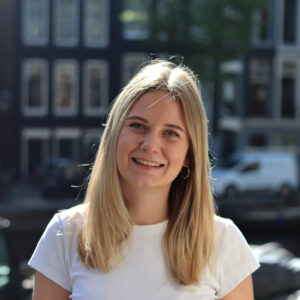
Many young professionals are taking the step to kickstart their careers abroad, and Ronja is a great example. About five years ago, she decided to move to the Netherlands to grow both personally and professionally. Since then, she has built a promising career at one of the country’s largest banks through Young Financials.
What were the first impressions of the Netherlands?
It’s been relatively easy for me to integrate in some ways, while other aspects are more challenging. I like the directness; the whole “let’s not blabber around.” When you compliment someone, you mean it. When you ask someone how they are, you actually care. Of course, not speaking fluent Dutch is a big thing, and you can’t ignore that. It’s not a daily blocker because I can manage basic things in Dutch. But now that I’m in a football team where I’m the only non-Dutch person, I notice the barrier more. I can’t chat with the girls in the same way they chat with each other, because I have to respond in English.
What was your first impression on the Dutch job market?
I think one big thing is the work–life balance. I really noticed it in the summer: when it’s sunny, people log off a bit earlier, and when the weather is bad, you work a bit longer and balance your hours. I really enjoy that flexibility the organization offers. And honestly, it is a privilege. It’s very trust-based, which I really appreciate. For me it works well: on days when I’m motivated, I might do a bit extra, and the next day, if I have a doctor’s appointment, I can log in earlier without being micromanaged. But because you’re given that trust, you also want to be worthy of it.
Were there also challenges you faced while starting to work in the Netherlands?
Coming straight from university as a junior, you need to be open to feedback and actively ask for it. But sometimes the feedback you ask for is really hard to hear. You still need to take it in, maybe think about it at home, and remind yourself: business is not personal. The feedback is about your work, not your personality. I also work in a male-dominated industry, so sometimes feedback or blunt comments just come your way, even when you didn’t ask for them. That’s been a learning curve for sure, especially throughout my whole job-seeking process.
How did you find your support for Young Financials and the whole process with us?
It all went very fast; in a good way. I really liked that, because when you apply for jobs you often get no reply at all. Overall, the whole process, from me calling to starting my job, was about three to four weeks. My contact person from Young Financials throughout the process made a big difference. As an international, I had challenges: I didn’t have a Dutch bank account, I have a foreign passport, and I needed certain documents or translations. My contact person answered everything immediately, which gave me a lot of transparency. She also prepped me for the interviews, joined me at one of them, gave feedback afterwards, and even monitored how things were going after I started.
My team lead was in touch with her for at least six months after I joined. I always knew that if I had a question about a sick day, development budget, anything, Young Financials was my first point of contact, and they would connect me to the right person. That was incredibly valuable as a newcomer who didn’t know the organization yet.
Can you tell something about your current role?
I work as a business analyst in the External Reporting department at a Dutch bank, specifically for Wholesale & Rural clients. My team works as a kind of bridge between IT and the financial report producers. It has been a big learning curve. I basically had to learn two things at once: the accounting side and the coding side, even though I had never coded before. In the beginning I felt a lot of imposter syndrome, like I wasn’t qualified. However, they weren’t looking for someone to challenge their expertise, but someone who would ask the simple, critical questions: Why are we doing this? Does this make sense? Could we do it differently? That’s where I found my place. I often end up being the person in the middle who explains things in simpler terms. And I think that ties into being a junior in general. You don’t have deep content knowledge yet. What you bring is potential. To show it, you need to be proactive, curious, ask questions, and learn how to communicate, which is something I think many people, including myself, overlook.
What advice would you give to other young professionals who are considering to move abroad?
I would say this: if you’re thinking about it and you feel even a bit of courage or curiosity, give it a try. My parents always told me: If you get the opportunity to go, and you want to try it, then go. If you hate it, you can always come home. That takes some of the pressure off. Because the reality is: not everyone loves it. International life is very romanticized. Social media makes it look like you’re living the high life, and everything is perfect. But it’s not. It’s difficult. It’s lonely at times. It’s hard to start over in a place where you have no support network. But I don’t regret it for a second. It also brings you so much: personal growth, independence, self-awareness, hopefully confidence over time. It allows you to learn.
Are you ready to take the next step in your career like Ronja? We’re here to help! At Young Financials, we connect talented young professionals with job opportunities in the Dutch financial sector. Take a look at our vacancies, apply now, or get in touch with us via recruitment@youngfinancials.com to learn more!